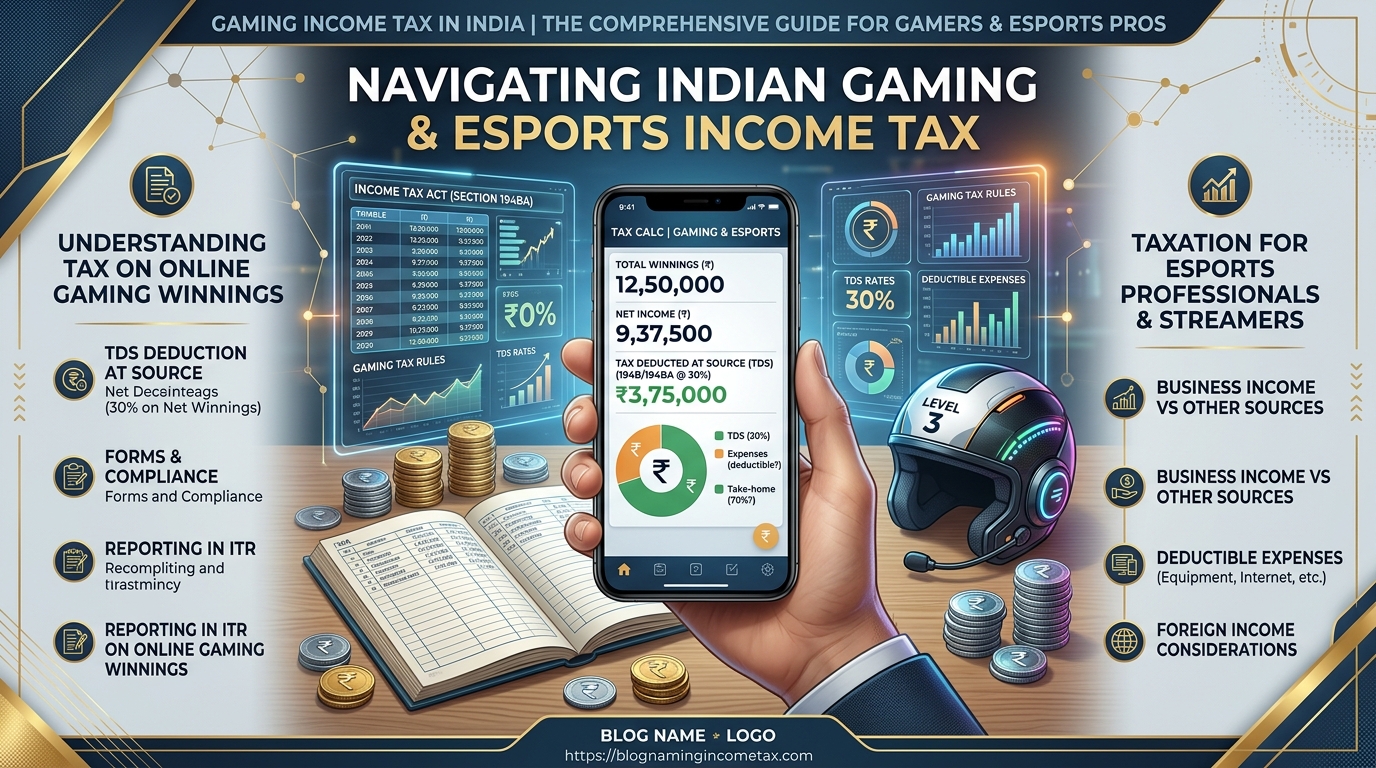
As competitive gaming evolves from a hobby into a full-time profession, esports players and content creators in India are pulling in significant earnings. However, with financial rewards comes tax compliance. If you earn money playing online games in India, you must navigate a flat 30% tax rate plus applicable surcharges.
In this article, we break down how the **30% TDS (Tax Deducted at Source)** works under Section 194BA, how net winnings are calculated, and how to file your gaming earnings in your ITR (Income Tax Return).
1. The 30% TDS Rule: Section 194BA Explained
In Budget 2023, the Government of India introduced **Section 194BA** specifically to govern tax deductions on winnings from online games. Under this section, online gaming platforms are required to deduct TDS at a flat rate of **30% on your net winnings** at the time of withdrawal or at the end of the financial year.
Important Update: Unlike other income segments, there is no ₹10,000 threshold limit for TDS under Section 194BA. Even if you withdraw ₹100 of net winnings, a 30% TDS is deducted.
2. How Net Winnings are Calculated
TDS is deducted from Net Winnings, not your gross withdrawals. The Ministry of Finance defines the formula for Net Winnings as follows:
Where:
- A: Total amount withdrawn during the financial year.
- B: Total deposits made by the user in the wallet during the year.
- C: Closing balance in the user's wallet at the end of the financial year.
- D: Opening balance in the user's wallet at the start of the financial year.
This ensures you are only taxed on the actual profits you make from the platform rather than the deposit capital you invested.
3. How to Report Gaming Income in Your ITR
When filing your annual Income Tax Return (ITR), online gaming income must be declared under a specific tax head:
Income from Other Sources (Section 115BBJ)
For casual players, tournament winnings must be declared under **Income from Other Sources** under **Section 115BBJ**. This income is taxed at a flat rate of 30% (plus a 4% health & education cess, making the effective rate **31.2%**). You cannot claim any basic exemption limits or standard tax deductions (like Section 80C, 80D, etc.) against this specific segment.
ITR Forms for Esports Professionals
If you are a professional esports athlete, a salaried team player, or an esports content streamer, your tax filing gets slightly more detailed:
- ITR-1 or ITR-2: Used if online gaming is your side income, and you have salary, house property, or interest income.
- ITR-3 or ITR-4 (Business or Profession): Used if you earn sponsorships, stream salaries, brand endorsements, or coaching contracts. Here, you are considered a professional. You can declare your salaries and sponsorships under business income and claim **deductible business expenses** (such as gaming smartphones, PCs, internet bills, electricity, and coach salaries) to lower your taxable business profits. However, your *direct gaming winnings* (from scrims or tournaments) will still be taxed at a flat 30% under Section 115BBJ.
4. Claiming Credit for TDS Already Deducted
When a platform like Virtual Esports deducts 30% TDS, it deposits this money with the Income Tax Department against your PAN. You can verify this deduction by downloading your **Form 26AS** or checking your **AIS (Annual Information Statement)** on the e-filing tax portal. When filing your ITR, you can claim this TDS amount as a tax credit, which will offset your final tax liability or be refunded if you've overpaid.
Conclusion & Compliance Checklist
To avoid penalties, audit flags, or double taxation:
- Ensure your PAN card is verified and linked to your gaming platform wallet.
- Verify your TDS deductions quarterly on Form 26AS.
- Report all gaming earnings under Section 115BBJ.
- Consult a chartered accountant (CA) to determine if filing as a business (ITR-3) can help you claim deductions on your hardware setup.
At Virtual Esports, we ensure 100% tax compliance under Section 194BA. All TDS certificates are processed and shared automatically, letting you focus on the game while we handle the back-end compliance.